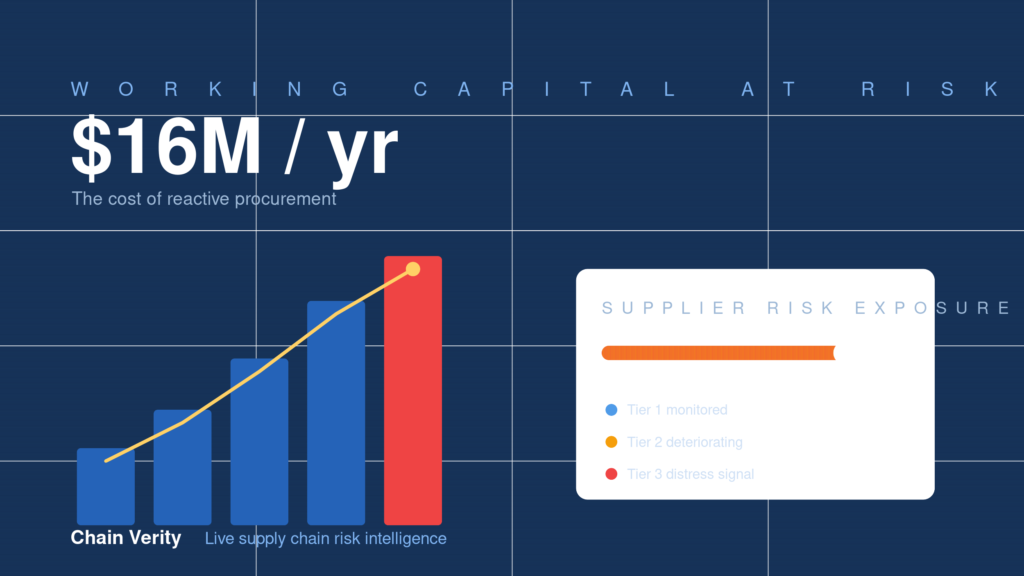
The cost of reactive procurement is no longer a soft, hard-to-measure number. It shows up in lost revenue, emergency freight, idle production lines, and earnings calls. When a procurement team waits for a supplier to fail before acting, the bill arrives fast. Direct procurement disruptions now cost organizations an average of $16 million a year, according to Coupa’s State of Direct Procurement 2026 report, and a single active disruption can drain roughly $1.5 million per day while it runs.
The short answer to “what does reactive procurement cost?” is this: more than the monitoring that would have prevented it. The teams that find out about a supplier’s distress from a headline are the same teams paying spot-market prices to replace that supplier under pressure.
The bill compounds over time
Reactive procurement is expensive in any single year, but the damage accumulates. McKinsey estimates that supply chain disruptions cost the average organization 45 percent of one year’s profits over the course of a decade. A single prolonged production shock can wipe out 30 to 50 percent of one year’s EBITDA. These are not freak events. Companies experience a disruption lasting one to two months roughly every 3.7 years, which means the question is not whether a major shock arrives but whether procurement sees it coming.
That distinction matters because the cost of a disruption is largely set by how late you respond. Early detection buys options: qualify a second source, renegotiate, build buffer stock, or exit a contract before renewal. Late detection buys only expensive ones.
Leaders detect risk early. Laggards pay for it.
The gap between proactive and reactive procurement is measurable. Coupa’s research found that 60 percent of procurement leaders can detect supplier reliability and price risk early, compared with just 26 percent of laggards. The consequence is direct: laggards are 2.4 times more likely to lose revenue because of fulfillment failures.
The reason most teams stay reactive is structural, not lazy. Risk reporting is built around quarterly snapshots and tier-1 visibility. By the time a quarterly supplier review reaches the CPO’s desk, the financial data behind it is already stale, and the supplier most likely to fail often sits two or three tiers deep, well outside the field of view. Traffic-light scorecards make this worse by reducing complex financial deterioration to a green dot that does not move until it is too late.
What proactive procurement looks like
The alternative is continuous, financially grounded monitoring rather than periodic review. McKinsey’s own conclusion is that the era of reactive, crisis-driven supply chain management has to give way to proactive resilience-building: the data, analytics, and organizational habit of managing capacity before a shock, not during one.
In practice that means three things. First, watch financial signals continuously instead of quarterly, because credit deterioration and earnings misses are leading indicators that scorecards miss. Second, extend visibility past tier 1 into the sub-tier suppliers where most disruptions actually originate. Third, quantify exposure in dollars, not colors, so the working capital at risk behind each supplier is a number a CFO can act on.
This is the gap Chain Verity (chainverity.ai) was built to close. The platform tracks 200-plus financial signals per supplier across tiers 1, 2, and 3, converts that into working capital at risk in actual dollars, and replaces the quarterly snapshot with live monitoring. Procurement teams that want to test this against their own supplier base can request early access.
The cost of reactive procurement is not a line item you will find on a budget. It hides inside the emergency orders, the lost sales, and the renewals signed without knowing the counterparty was already in trouble. Making it visible is the first step to making it smaller.
Frequently Asked Questions
Q: How much does reactive procurement actually cost?
A: Direct procurement disruptions cost organizations an average of $16 million per year, according to Coupa’s State of Direct Procurement 2026 report. While a disruption is active, the impact can reach about $1.5 million per day. Over a decade, McKinsey estimates supply chain disruptions cost the average company 45 percent of one year’s profits.
Q: Why do procurement teams stay reactive instead of proactive?
A: Most risk reporting is built on quarterly snapshots and tier-1 visibility. Financial data is stale by the time it reaches decision-makers, and the suppliers most likely to fail often sit in tiers 2 and 3, outside standard monitoring. Traffic-light scorecards also hide gradual financial deterioration until it becomes a crisis.
Q: What is the difference between proactive and reactive procurement?
A: Reactive procurement responds to supplier failures after they happen, usually at premium cost. Proactive procurement monitors supplier financial health continuously, detects distress early, and acts while options like resourcing or renegotiation are still cheap. Coupa found leaders who detect risk early are far less likely to lose revenue to fulfillment failures.
Q: How can a procurement team reduce the cost of disruptions?
A: Move from periodic to continuous monitoring, extend visibility beyond tier-1 suppliers into the sub-tiers where most disruptions originate, and measure risk in dollar exposure rather than color-coded scores. This shifts spending from emergency response toward prevention, where it is far cheaper.
