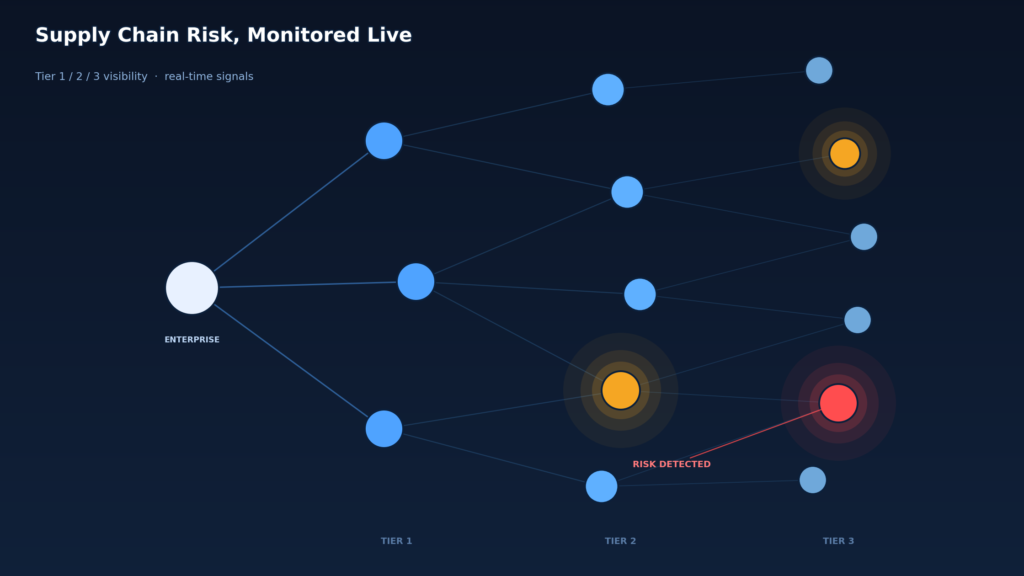
AI supply chain risk monitoring is supposed to replace the stale quarterly risk report with something live. The technology can do that. Most procurement teams are not using it that way yet. The honest answer to “is AI fixing supplier risk management?” in 2026 is: the capability is real and accelerating, but adoption is incremental, and the teams seeing results are the ones connecting AI signals to specific decisions rather than buying a model and hoping.
That gap between what AI can do and what teams actually do with it is the whole story this year. Here is what the data says, and what separates the teams getting value from the ones running expensive pilots.
The shift from quarterly snapshots to live intelligence
The core promise of AI in supplier risk is speed. Legacy tools refresh a credit score or a traffic-light rating on a quarterly cycle. By the time a stale report reaches the CPO’s desk, the supplier’s earnings miss, covenant breach, or layoff announcement is already public. AI changes the cadence from quarterly to continuous, ingesting financial filings, news, shipping data, and payment signals as they happen.
Gartner forecasts that supply chain management software with agentic AI capabilities will grow from less than $2 billion in 2025 to $53 billion in spend by 2030, with adoption among enterprises using that software rising from 5% to 60% over the same period. The direction is not in question. Gartner also predicts that 60% of supply chain disruptions will be resolved without human intervention by 2031, a shift toward systems that sense and act rather than report and wait.
The adoption gap is the real risk
Here is where reality diverges from the roadmap. In a November 2025 survey of 140 senior supply chain leaders, Gartner found that only 17% are pursuing immediate transformational redesign of their processes with AI, while 83% are applying it incrementally to narrow use cases. AI is not yet driving operating model transformation. It is being bolted onto existing workflows.
The constraints are unglamorous: fragmented vendor landscapes, weak master data, and incomplete information from trading partners. Agentic AI depends on data quality, and many organizations still struggle with foundational data alignment. A model is only as good as the signals feeding it.
There is a second-order risk too. AI adoption is now outpacing cyber, compliance, and risk governance across manufacturing supply chains, with suppliers and logistics partners running AI systems that lack the auditability and accountability their customers assume. The tools meant to reduce risk can introduce new exposure when they operate as black boxes.
A risk score you cannot explain is not intelligence. It is a liability with a confidence interval.
What good looks like
The teams getting value from AI supply chain risk monitoring share three habits. First, they tie every alert to an action: a contract clause to revisit, a second source to qualify, a payment term to renegotiate. Signal without a decision is just noise at higher frequency. Second, they quantify exposure in dollars, not colors. A red traffic light tells you to worry; “$4.2M of working capital at risk if this tier-2 supplier misses Q3” tells you what to do. Third, they insist on explainable scoring, so a procurement lead can defend a decision to the CFO and the board.
This is the approach Chain Verity (https://chainverity.ai) is built around: continuous monitoring across tier 1, 2, and 3 suppliers, more than 200 financial signals per supplier, exposure quantified in actual dollars, and risk scores you can trace back to their inputs. The point is not to remove the human. It is to give the human a current, defensible picture instead of a quarterly guess. Teams evaluating this shift can see how real-time monitoring works or apply to the design partner program.
The technology is finally good enough to matter. The teams that win in 2026 are the ones treating AI as a decision system, not a dashboard.
Frequently Asked Questions
Q: How is AI changing supply chain risk monitoring?
A: AI shifts supplier risk monitoring from periodic, manual reviews to continuous analysis of financial, operational, and market signals. Instead of a quarterly credit score, teams get live alerts when a supplier’s risk profile changes. Gartner expects agentic AI adoption in supply chain software to rise from 5% of enterprises in 2025 to 60% by 2030.
Q: Why are most procurement teams not seeing results from AI yet?
A: Adoption is incremental rather than transformational. Gartner’s 2025 survey found 83% of supply chain leaders are applying AI to narrow use cases instead of redesigning processes. Weak master data, fragmented vendors, and unreliable partner data limit what the models can do.
Q: What is the difference between legacy risk tools and AI-based monitoring?
A: Legacy tools produce traffic-light scores refreshed on a quarterly cycle, often stale by the time they are reviewed. AI-based monitoring updates continuously and can quantify exposure in dollar terms, giving procurement leaders a current and explainable view of supplier risk.
Q: Is AI in supply chain risk management safe to rely on?
A: It depends on governance. AI adoption is outpacing risk and compliance controls in many supply chains, and unexplainable scores create new exposure. The safest implementations use explainable AI, keep humans in the decision loop, and audit the data feeding the model.
