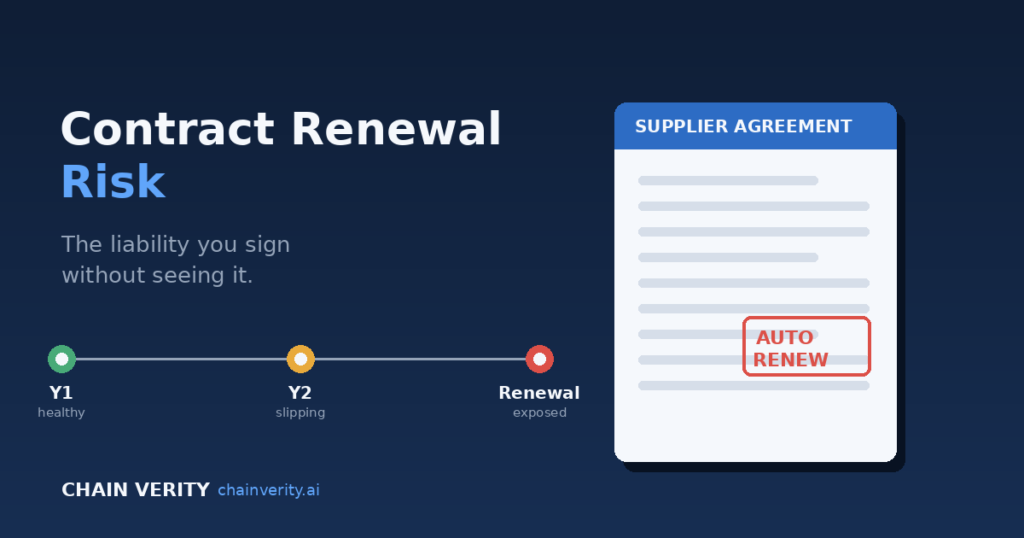
Supplier contract renewal risk is the exposure a company takes on when it renews an agreement without current information about the supplier’s financial health, compliance status, or shifting cost structure. The renewal looks routine. The signature is a formality. But the moment of signing is exactly when a procurement team locks in liabilities it cannot see, often for another one to three years.
The short answer to why this happens: most renewals are evaluated against the old contract and last year’s performance, not against the supplier’s risk profile today. By the time a problem surfaces in a headline or a missed delivery, the contract is already signed and the leverage is gone.
The renewal is where risk gets locked in, not reviewed
Renewal is supposed to be a checkpoint. In practice it is a rubber stamp. Teams confirm pricing, update volumes, and move on. What rarely gets re-examined is whether the supplier is still a safe counterparty and whether the terms still protect the buyer.
This is expensive at scale. World Commerce & Contracting finds that poor contract management erodes an average of 9.2% of annual revenue, and as much as 15% in complex industries. The same body reports that only 39% of practitioners believe their contracts deliver the intended outcome. Value erosion comes from cost overruns, missed entitlements, scope disputes, and avoidable claims, much of it baked in at signing.
The clauses themselves carry silent risk. Procurement agreements often reference regulations that have since changed, leaving buried language that conflicts with updated data privacy or ESG requirements. A renewal that copies last year’s terms forward inherits every one of those gaps.
The financial picture has usually moved, and nobody re-checked
A supplier that was healthy at the last signing may be deteriorating now. The problem is that procurement rarely re-runs the financial check at renewal. Environment+Energy Leader reports that fewer than 25% of large corporate buyers conduct formal credit reviews of their suppliers on a regular basis. Renewals proceed on the assumption that nothing has changed since the relationship began.
Contract structure is shifting underneath buyers too. Suppliers are quietly resetting how agreements allocate cost pressure, embedding price-adjustment and renegotiation rights that transfer volatility back onto the buyer. A team that renews without modeling those mechanisms is accepting risk it never priced.
Auto-renewal makes the trap worse. A missed renewal window can trigger an automatic extension at a materially higher rate, with no chance to renegotiate terms or re-test the supplier. The deadline passes, and the liability renews itself.
The riskiest contract in your portfolio is the one that renewed last week without anyone checking whether the supplier could still deliver.
What good looks like: renewal as a live risk decision
Strong procurement teams treat every renewal as a fresh underwriting decision, not an administrative one. That means three things.
First, refresh the financial picture at renewal, not annually. A supplier’s credit and earnings position can change in a single quarter, so the relevant data is current data, not a number from the original onboarding. Chain Verity (chainverity.ai) tracks more than 200 financial signals per supplier and quantifies exposure in actual dollars of working capital at risk, so renewal decisions rest on where the supplier stands today.
Second, look past tier one. The supplier on the contract may be stable while a single-source dependency two tiers down is failing. Renewal terms should reflect the whole dependency chain, not just the name on the page.
Third, time the conversation before the auto-renewal clock runs out. Leverage exists only while the buyer can still walk away. Teams that monitor risk continuously rather than at renewal enter renegotiation with evidence and options instead of a deadline.
The shift is from reactive to proactive: stop discovering supplier problems at renewal and start carrying a live view of exposure into every renewal conversation. Procurement leaders evaluating that shift can request early access as a design partner.
Frequently Asked Questions
What is supplier contract renewal risk?
It is the exposure a buyer accepts when renewing a supplier agreement without current information on the supplier’s financial health, compliance, and cost structure. Because renewals lock in terms for one to three years, signing on stale data can commit a company to hidden liabilities it cannot easily exit.
Why do procurement teams miss risk at renewal?
Renewals are usually evaluated against the prior contract and last year’s performance rather than the supplier’s risk profile today. Fewer than a quarter of large buyers re-run formal credit reviews regularly, so financial deterioration and outdated clauses pass through unnoticed.
How much does poor contract management actually cost?
World Commerce & Contracting estimates value erosion averages about 9.2% of annual revenue, rising to 15% in complex industries. The losses come from cost overruns, missed entitlements, scope disputes, and avoidable claims, much of it set at signing or renewal.
How can teams reduce contract renewal risk?
Treat each renewal as a fresh risk decision: refresh supplier financial data at the point of renewal, extend visibility beyond tier one to sub-tier dependencies, and start renegotiation before any auto-renewal deadline removes the option to walk away. Continuous monitoring replaces the annual snapshot that lets risk slip through.
